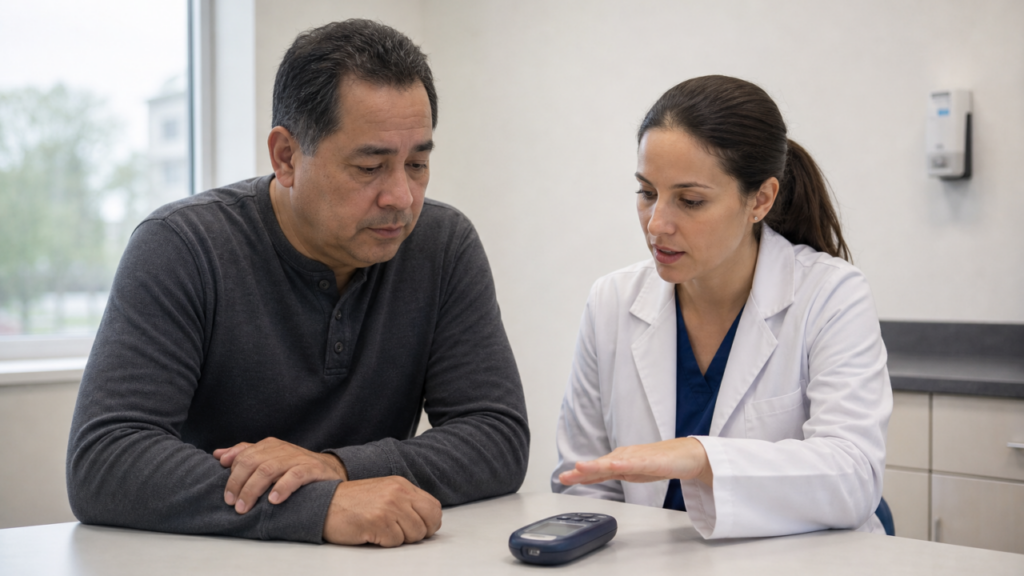
An AI-driven platform could one day let people communicate more directly with implanted or wearable medical devices, giving patients alerts and a way to share symptoms from a phone app. The idea is still early, but it reflects a fast-moving trend in which device data, patient reports and generative AI are being linked in a single system. In the study highlighted by The Washington Post, the prototype was tested in epilepsy and designed to work through a secure smartphone app. The Washington Post reported that the researchers see broader uses in devices such as insulin pumps and cardiac implants. https://www.washingtonpost.com/health/2026/10/14/with-ai-platform-patients-could-chat-with-medical-devices-improve-health/
What happened
According to the published study indexed in PubMed, the system connects brain-signal data from implanted or scalp electrodes to secure large language models, allowing bidirectional communication through a smartphone app. The authors describe it as a prototype for devices that could rapidly adapt to patient and clinician needs, rather than a finished product ready for routine care. The Washington Post’s reporting focused on the patient-facing interaction: personalized alerts, symptom reporting and a chat-like interface built around health data instead of a general-purpose chatbot. https://pubmed.ncbi.nlm.nih.gov/41646755/
The research was centered on epilepsy, where seizure-related signals can sometimes be detected before a seizure happens. That timing matters because a device that identifies a pattern early may be able to notify the person sooner, potentially giving them time to take a precaution or contact a clinician. The study also points to possible future uses in other device-based treatments, but that broader application is still a proposal, not proof. https://pubmed.ncbi.nlm.nih.gov/41646755/
Why it matters
Medical devices already generate large amounts of information, but in many cases the data do not flow back to the patient in a useful, understandable form. A system that can translate device signals into plain-language alerts could make care feel more responsive. It might also make it easier for people to report symptoms in real time, rather than waiting for the next appointment or relying on memory later. The appeal, from a patient perspective, is not just more data, but more usable data. https://pubmed.ncbi.nlm.nih.gov/41646755/
At the same time, the concept raises obvious safety concerns. A system that sounds conversational can also sound authoritative, even when it is uncertain. For that reason, the distinction between a well-scoped medical-device interface and a general chatbot is important. The FDA has said its oversight of AI-enabled medical devices includes evaluation of safety and effectiveness, and it has separately released a discussion paper on generative AI-enabled medical devices to gather feedback on regulation, performance and risk management. https://www.fda.gov/medical-devices/digital-health-center-excellence/artificial-intelligence-enabled-medical-devices
What the evidence actually shows
For now, the evidence supports feasibility, not real-world clinical benefit. The PubMed entry for the study describes a prototype and a proposed platform; it does not establish that the system improves seizures, reduces complications or outperforms standard care. That is a key line readers should keep in mind: a device can be technically impressive and still require much more testing before it is used broadly. https://pubmed.ncbi.nlm.nih.gov/41646755/
The FDA’s current materials on AI-enabled medical devices emphasize that premarket review considers a device’s overall safety and effectiveness, including whether study designs are appropriate for the intended use. The agency also says transparency matters for patient-centered care and for maintaining a device’s performance over time. Those points are especially relevant for generative AI, where outputs can be persuasive even when they are incomplete or wrong. https://www.fda.gov/medical-devices/artificial-intelligence-enabled-medical-devices/list-artificial-intelligence-enabled-medical-devices?_bhlid=315a35805e59d0209d67df3d3ae62dd3141a27f4
The broader regulatory context matters too. FDA materials note that there are now many authorized AI-enabled medical devices in the United States, showing that AI is already part of medical technology rather than a future concept. But the same agency also warns that changes in input data can alter performance, which is one reason postmarket monitoring and human oversight remain important. https://www.fda.gov/medical-devices/digital-health-center-excellence/artificial-intelligence-enabled-medical-devices
What remains uncertain
Several major questions remain unresolved. First, it is not yet clear how well a conversational interface would perform outside a research setting, where patients have varying levels of comfort with technology, symptoms may be more complex, and device data may be noisier. Second, researchers still need to show whether such systems reduce harm, improve adherence or help clinicians make better decisions. Third, there is the issue of trust: if an app generates an alert or suggestion, users need to know when to treat it as a prompt for action versus information that still needs human review. https://pubmed.ncbi.nlm.nih.gov/41646755/
There is also a practical safety issue that applies to all health-focused AI systems: people may not provide enough context, and models may return mixed-quality information. Recent AP coverage of health-related AI discussions noted that real-time patient interactions can produce uneven answers, which is one reason experts continue to stress guardrails and supervision. That concern is especially important when AI is tied to a medical device, where mistakes could affect treatment decisions or delay care. https://apnews.com/article/c46134f39189049047b5c37d208e1e47
What patients and clinicians may want to ask
If this kind of tool becomes available in clinical settings, a useful conversation with a clinician would focus on four basics: what the device is allowed to do, who reviews the data, how quickly alerts are acted on, and what happens if the AI gives a confusing or incorrect response. Patients may also want to ask whether the system is FDA-cleared or otherwise reviewed for the specific use being offered, and whether any part of the conversation is stored, shared or used to retrain the model. FDA guidance materials suggest those questions are central to transparency, validation and postmarket safety. https://www.fda.gov/medical-devices/artificial-intelligence-enabled-medical-devices/list-artificial-intelligence-enabled-medical-devices?_bhlid=315a35805e59d0209d67df3d3ae62dd3141a27f4
People should not assume that a chat-based interface makes a device safer or more accurate on its own. In health care, better communication can help, but only if the underlying signals, software and clinical workflow are reliable. This study suggests a new direction for patient-device communication; it does not yet show that the direction is ready for everyday use. https://pubmed.ncbi.nlm.nih.gov/41646755/
For readers, the practical takeaway is simple: this is a promising prototype, not a treatment breakthrough. If you use a medical device and receive an unexpected alert, new symptom advice or urgent warning, contact your care team promptly rather than relying on the device alone. https://pubmed.ncbi.nlm.nih.gov/41646755/
Sources
- The Washington Post: With AI platform, patients could chat with medical devices to improve health (2026-10-14)
- PubMed: An Implantable Device that Converses with Patients and Learns to Co-Manage Epilepsy (2026-03-09)
- FDA: Artificial Intelligence-Enabled Medical Devices (2026-09-2026)
- FDA: Considerations for the Regulation of Generative AI-Enabled Medical Devices: Discussion Paper and Request for Feedback (2026-08-2026)
- FDA: Transparency for Machine Learning-Enabled Medical Devices: Guiding Principles (2026-09-2026)
- FDA: List of Artificial Intelligence-Enabled Medical Devices (2026-09-2026)
- AP News: RFK Jr.'s embrace of AI confounds some MAHA allies and medical experts (2026-10-12)
Was this article helpful?
Thanks for your feedback — it helps us improve our coverage.
Get the Daily Health View briefing
The day's most important health news, explained clearly. One short email a day. Unsubscribe anytime.
