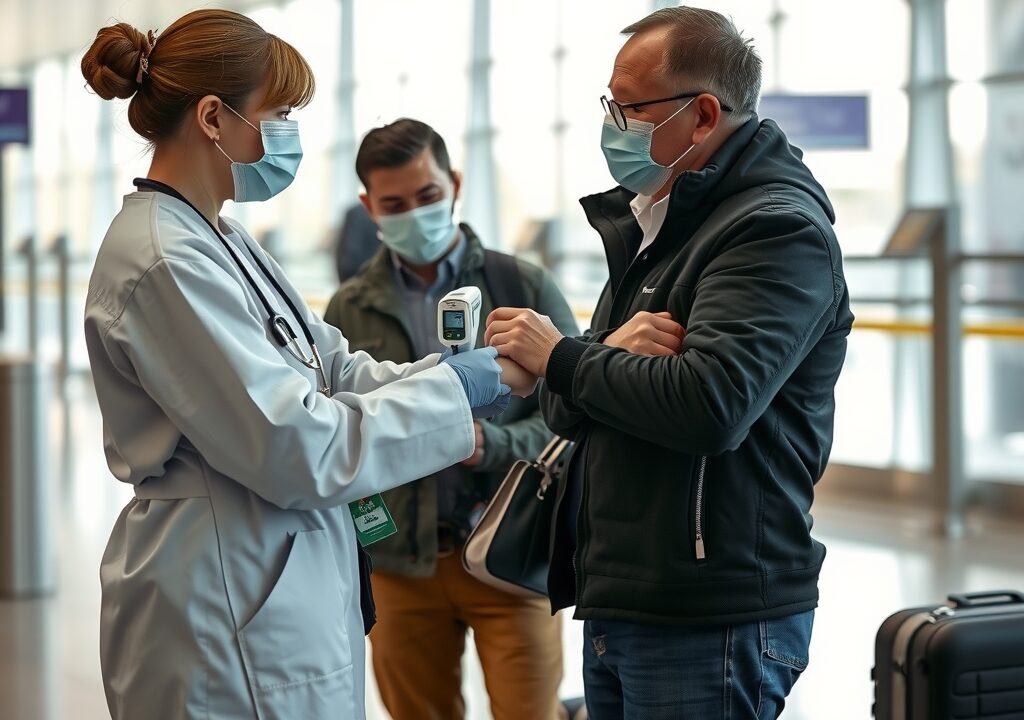
Health officials in Africa are trying to piece together a difficult epidemiological puzzle: whether the first confirmed Ebola patients in Nigeria and Kenya crossed paths at Uganda’s Entebbe International Airport. The possibility does not prove direct transmission, but it shows how quickly a dangerous virus can become a cross-border tracking problem once travel is involved.
The report comes amid a broader outbreak that began in the Democratic Republic of the Congo and has since been detected in several countries. Public-health teams are focusing on contact tracing, isolation, and travel histories to determine whether the cases reflect separate importations or a chain of infection that has not yet been fully mapped.
What happened
According to AP reporting, African health officials said the first Ebola patients confirmed in Nigeria and Kenya may have passed through the same airport in Uganda earlier this month. The information emerged as investigators tried to reconstruct the movements of infected travelers and identify anyone who may have been exposed along the way.
AP also reported that the Nigeria case involved a traveler who had recently been in Uganda, while Kenya’s first known patient had traveled through Uganda after leaving Congo. Health authorities are still determining whether the airport link represents a shared exposure, a coincidence, or something else entirely. That uncertainty matters because Ebola can spread through direct contact with bodily fluids, not through casual contact or simply sharing public space in the way many respiratory viruses do. CDC guidance says Ebola spreads through direct contact with blood or other body fluids from a sick person, or with contaminated objects or surfaces. https://cdc.gov/migration-border-health/media/pdfs/366517-A_PUB_EbolaFAQIPCPointsEntry_07062026_508pass.pdf
Why it matters
Ebola outbreaks are treated as urgent public-health events because delays in finding cases can allow the virus to spread before patients are isolated. CDC says early recognition, rapid isolation, infection-control precautions, and monitoring of contacts are central to outbreak response. In an active outbreak, the speed of tracing can be as important as the treatment given to any one patient. https://www.cdc.gov/ebola/hcp/clinical-guidance/index.html
The current outbreak has also drawn attention because it is not confined to one place. AP reported that the disease, which began in Congo in May, has been detected in multiple African countries. CDC’s outbreak summary likewise says it is responding to an Ebola outbreak caused by Bundibugyo virus in the Democratic Republic of the Congo and notes that limited health infrastructure and supplies make control harder. https://apnews.com/article/aad964dbbbca2f39e00739108ef7fc0a
What the evidence actually shows
At this stage, the airport theory is an investigative lead, not a conclusion. Travel overlap can help explain how separate cases may be connected, but it does not by itself establish who infected whom, where the exposure occurred, or whether both patients were infected before reaching the airport.
That distinction matters because outbreak investigators use travel timelines, symptom onset, test results, and contact tracing to decide whether cases belong to the same transmission chain. CDC says Ebola symptoms usually begin after an incubation period and can initially resemble other illnesses, which can delay diagnosis if the disease is not suspected early. https://www.cdc.gov/ebola/signs-symptoms/
AP’s reporting indicates that health officials are still working through those timelines. The Kenya case has already generated follow-up cases, and AP has reported that authorities in Nigeria and Kenya are tracking contacts and isolating patients as they assess the situation. That kind of monitoring is standard during an outbreak, especially when new cases appear in different countries with recent travel histories. https://apnews.com/article/c96067b4b2fc8d3e35a97e32455e996c
What remains uncertain
Several important questions are still unresolved. Officials have not yet publicly confirmed that the two patients met each other, shared a vehicle, or were exposed to the virus in the airport itself. It is also not clear from the reporting whether they were infected in the same location before travel, infected separately, or connected by an earlier case that has not yet been identified.
Another unknown is how much wider the transmission network may be. AP has reported that the outbreak has spread beyond the original area in Congo and that health authorities are concerned about cases outside known contacts. In practical terms, that means investigators are still trying to determine whether the outbreak is being driven mainly by identifiable chains of transmission or by infections that are slipping past surveillance. https://apnews.com/article/aad964dbbbca2f39e00739108ef7fc0a
There is also uncertainty about how much risk this poses to the public outside the affected regions. CDC says the risk of Ebola spreading in the United States is low because of public-health protections and infection-control measures, but that statement reflects a well-resourced system and does not lessen the urgency of finding cases early where outbreaks are active. https://www.cdc.gov/ebola/situation-summary/index.html
Practical context for readers
For most readers, the main takeaway is not to fear airports, but to understand why travel history matters in outbreak response. If someone develops fever, severe weakness, vomiting, diarrhea, unusual bleeding, or other serious symptoms after travel to an area with known Ebola transmission, prompt medical evaluation is important. CDC advises healthcare providers to isolate suspected cases quickly and contact public health officials for testing guidance. https://www.cdc.gov/ebola/signs-symptoms/
Travelers to affected regions should pay close attention to official health guidance, including any screening or monitoring instructions. People who are not exposed to Ebola through direct contact with bodily fluids are not considered at the same level of risk as healthcare workers, household caregivers, or others with close contact with a sick person. CDC notes that those caring for an Ebola patient without proper infection control face the highest risk. https://www.cdc.gov/ebola/about/
For the general public, the broader lesson is that outbreak control depends on speed, coordination, and accurate information. A possible airport link may help investigators narrow the search for exposures, but the real work is still the same: identify contacts, isolate confirmed cases, and stop hidden chains of transmission before they widen further.
Sources
- AP News: First Ebola patients in Nigeria and Kenya might have crossed paths at Uganda airport (2026-10-22)
- AP News: What to know about Ebola outbreak that has spread from Congo to multiple African countries (2026-10-21)
- AP News: Kenya announces 2nd Ebola death, a close relative of the first patient (2026-10-24)
- CDC: Ebola Disease Basics (2026-06-01)
- CDC: How Ebola Spreads: Fact Sheet (2026-09-01)
- CDC: Clinical Guidance for Ebola Disease (2026-06-01)
Was this article helpful?
Thanks for your feedback — it helps us improve our coverage.
Get the Daily Health View briefing
The day's most important health news, explained clearly. One short email a day. Unsubscribe anytime.
