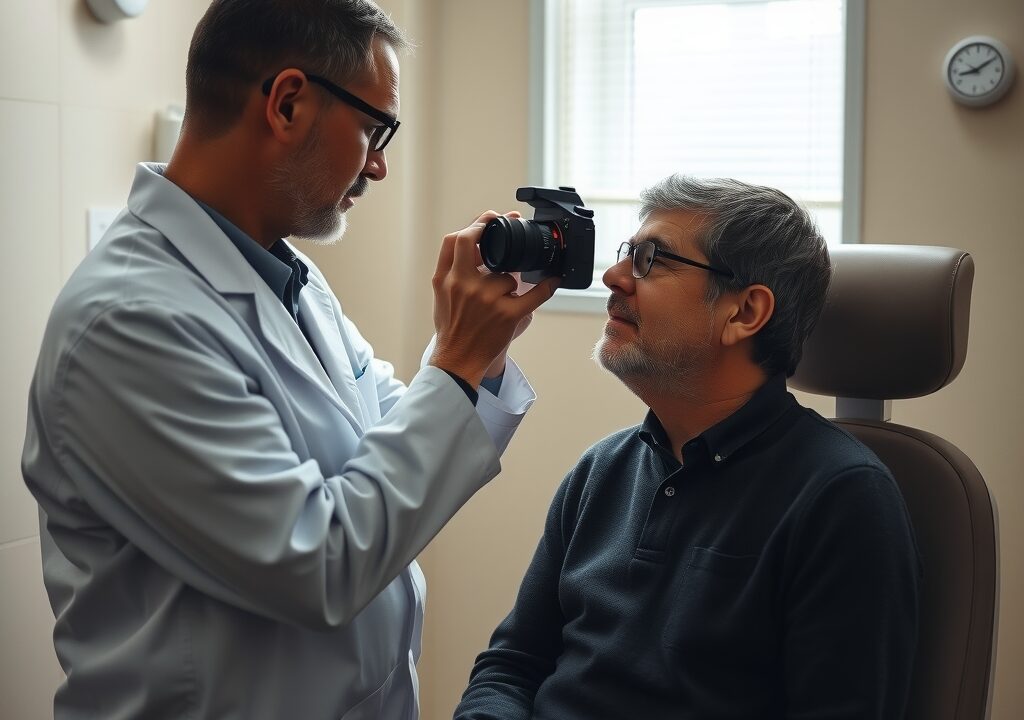
A face photograph may sound like an unlikely medical tool, but a new study suggests artificial intelligence can extract patterns from ordinary clinical images that correlate with cancer survival. The research, published in The Lancet Digital Health and reported by The Washington Post, adds to a growing body of work exploring whether a person’s appearance can reflect aspects of biological aging and overall health.
That does not mean a selfie can diagnose cancer or determine an individual patient’s future. The findings are early, and the researchers themselves frame the work as a prognostic signal that would need careful validation before it could be considered for routine use in oncology.
What the study examined
The new system, described as FAHR-FaceSurvival, was trained on a large set of facial photographs from people with cancer and linked to survival outcomes. According to the newspaper report, the model was developed from more than 40 million photographs overall and tested in oncology data that included more than 30,000 patients. The research report in PubMed describes a related FaceAge program that uses facial photographs to estimate biological age, and another published analysis found that FaceAge could help predict survival and early mortality across a large oncology cohort. The Washington Post reported that the highest-risk group identified by the model had much worse short-term survival than the lowest-risk group. The peer-reviewed FaceAge work also found that a person whose face looked older than their chronological age tended to have poorer outcomes. Because this is an observational prediction study, those patterns show association, not proof that the photograph is causing anything or that the model improves care.
Why researchers are interested
Oncologists already use many signals to estimate prognosis, including cancer type, stage, treatment response, scan findings, lab values, and overall physical condition. The appeal of facial-image models is that they are simple to obtain and could, in theory, add another layer of information without requiring a blood draw or imaging procedure. In the earlier FaceAge study, researchers reported that the model could improve physicians’ survival predictions when added to clinical information in patients with incurable cancer receiving palliative treatment. A separate PubMed-indexed study this year also reported that FaceAge estimates helped predict survival across 28 cancer types in a large dataset of radiation therapy patients.
That said, a tool being able to predict risk is not the same thing as being clinically useful. A model has to prove that it performs well in real-world settings, across diverse populations, and that it leads to better decisions or better outcomes, not just more accurate scores.
What the evidence actually shows
At this stage, the evidence suggests that facial photographs may contain subtle clues related to biological aging or frailty that correlate with survival in cancer populations. The new study and earlier FaceAge research both point in that direction. The model’s attention maps reportedly focused on areas below the eyes and around the nose, but researchers do not yet know exactly what features the system is using to reach its predictions. That uncertainty matters: AI can detect statistical patterns without explaining them in clinically meaningful terms.
The findings also need to be interpreted carefully because cancer prognosis is influenced by many variables. A photograph may reflect some of those factors indirectly, such as muscle loss, frailty, or general health status, but it does not replace a medical evaluation. And if a model is trained on one population, it may not transfer well to another without additional testing.
What remains uncertain
Several important questions remain unanswered. First, it is not yet clear whether the model works equally well across different cancer types, treatment settings, and patient populations. Second, researchers still need to show whether using the tool improves decisions made by clinicians. Third, any real-world use would need to address privacy, consent, bias, and transparency concerns, especially because facial images are sensitive data. Finally, a predictive model that performs well in a study can still fail when moved into routine care if the underlying data are incomplete, unrepresentative, or too tightly linked to a specific health system.
There is also a basic clinical question: if a model flags someone as higher risk, what should happen next? Without a clear response pathway, a prediction alone may create uncertainty rather than benefit.
What this could mean for patients and clinicians
For now, the most practical takeaway is modest. AI-based facial analysis is emerging as one more possible source of prognostic information in oncology research, but it is not a screening test and not a stand-alone decision tool. Patients should continue to rely on established cancer evaluations and should ask their care team how prognosis is being estimated, what factors are being considered, and whether any new tool is research-only or being used in practice.
If someone is noticing rapid weight loss, severe weakness, shortness of breath, confusion, new pain, or any other sudden decline during cancer treatment, that warrants prompt medical attention. Those symptoms matter far more than any experimental prediction score.
In the larger picture, the study fits a broader trend in medicine: AI is increasingly being tested not just to find disease, but to estimate risk and guide care. Whether facial-photo analysis becomes useful in oncology will depend on stronger validation, clearer clinical utility, and careful oversight before it is brought anywhere near routine patient care.
Sources
- The Washington Post: How a photo of a patient’s face could predict whether they’ll survive cancer (2026-10-20)
- PubMed: FaceAge as a biomarker for prognosis and treatment stratification in a large-scale oncology cohort (2026-05-01)
- PubMed: FaceAge, a deep learning system to estimate biological age from face photographs to improve prognostication: a model development and validation study (2025-06-01)
- PubMed: Face aging rate quantifies change in biological age to predict cancer outcomes (2026-04-28)
Was this article helpful?
Thanks for your feedback — it helps us improve our coverage.
Get the Daily Health View briefing
The day's most important health news, explained clearly. One short email a day. Unsubscribe anytime.
